Meet Our White Peafowl
The Ghost of the Garden: The History and Allure of White Peafowl
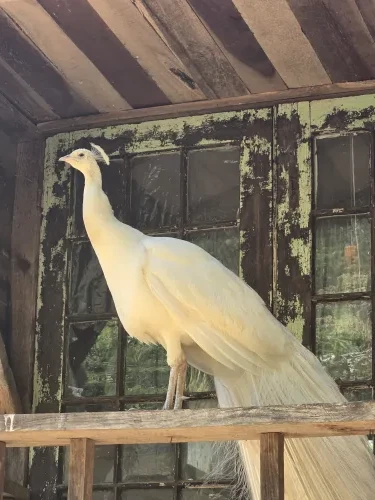
While the common Indian Blue Peafowl is famous for its vibrant iridescent plumage, the White Peafowl (Pavo cristatus mut. alba) captures the imagination with an elegance that feels almost ethereal. Often referred to as "the ghost of the garden," these birds are not a separate species, but a striking genetic variation that has captivated humans for centuries.
More Than Just a Color
It is a common misconception that the White Peafowl is an albino. Albinism is a condition resulting in a complete lack of pigment and typically features pink or red eyes. White Peafowl, however, possess a genetic mutation known as leucism.
This mutation prevents the distribution of melanin and other pigments to their feathers while leaving their eyes their natural dark color and their skin with its usual pigment. This results in the bird’s signature snowy-white appearance, which remains consistent across its entire life.
Origins and Selective Breeding
The original peafowl species, the Indian Peafowl, has been associated with human history for millennia—appearing in the iconography of ancient Greece, Rome, and India. The white mutation has likely appeared spontaneously in wild populations throughout history, but it was incredibly rare.
In the wild, a white peacock is at a significant disadvantage; their lack of camouflage makes them an easy target for predators. However, under human protection, the mutation was carefully preserved. Breeders in the 19th and 20th centuries recognized the striking aesthetic value of these birds and began selective breeding programs. By consistently pairing white birds, they stabilized the genetic line, making the "White" variety a permanent, albeit distinct, fixture in the world of ornamental poultry.
A Beacon of Elegance
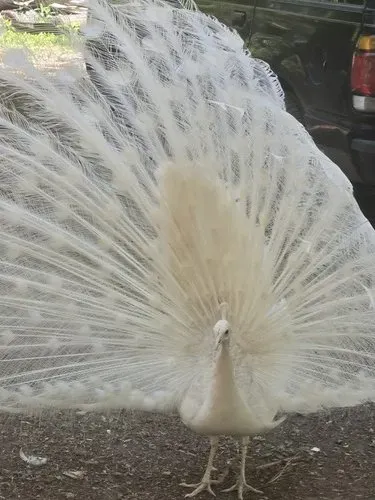
Because they lack the iridescent "eyes" (ocelli) found in the traditional peacock’s train, the White Peafowl’s display is often described as architectural. When a white peacock fans his tail, it creates a monochromatic, lace-like effect that stands out brilliantly against the deep greens of a garden or forest.
In historical gardens—from the estates of British royalty to the manicured landscapes of the American Gilded Age—the presence of white peafowl was a clear status symbol. They turned a property into a living canvas, representing luxury, tranquility, and a deliberate mastery over nature.
The Modern Ornamental Role
Today, the White Peafowl remains a prized bird for hobbyists and estate owners. While they share the same diet and general care requirements as their blue counterparts, their role is almost exclusively ornamental.
- The "Living Statue": Many keepers describe them as "garden art." Their ability to remain relatively still while displaying makes them a stunning focal point for landscape design.
- A Temperamental Difference? While they are genetically the same species as the blue variety, some breeders claim that the White Peafowl tends to be slightly more docile or "tame" due to generations of selective breeding in close contact with humans.
- The Preservation Movement: Dedicated heritage breeders continue to maintain the lines, ensuring that this unique genetic expression remains healthy and vibrant for future generations to admire.
Fun Fact: Even though they appear pure white, if you look closely at a white peacock’s train in bright, direct sunlight, you can sometimes see the faint outlines of the "eyes" (ocelli) in the feathers. It is as if the ghost of the colorful pattern is still there, waiting to be seen.
- The White Peafowl reminds us that nature often produces beauty not just through complexity, but through the absence of it. Whether they are wandering through an open pasture or standing proudly in a walled garden, they bring a touch of the extraordinary to the everyday landscape.